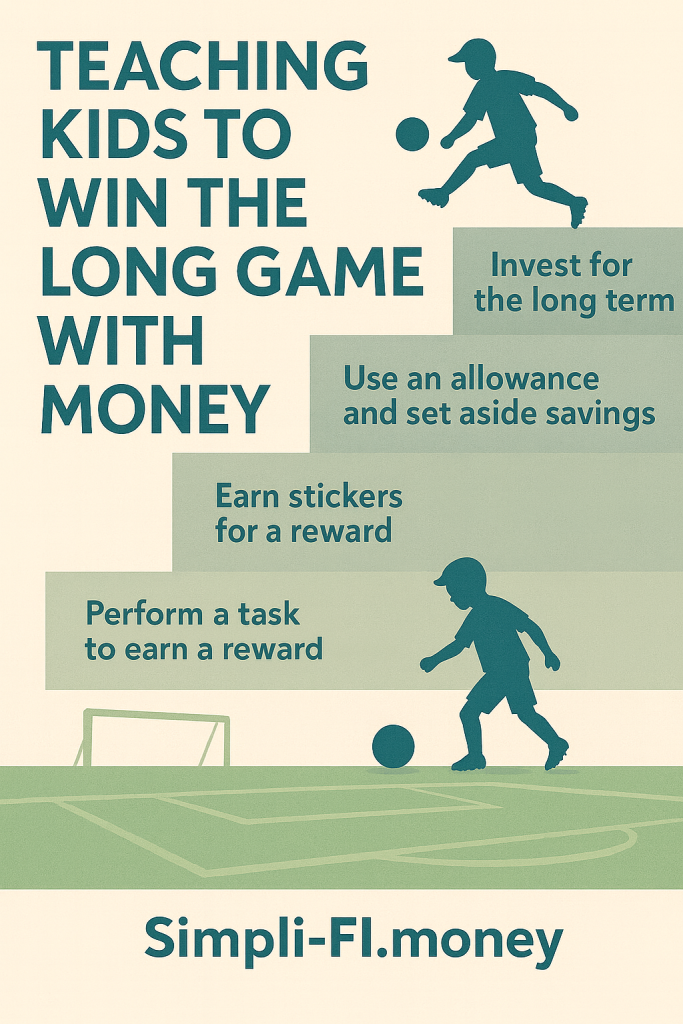
Over the next several posts, I’ll be sharing a series of articles for parents on how to develop financial habits in children—habits that grow naturally with age and maturity, just as athletic skills do. Each post will offer simple, practical ways to teach financial discipline at home, building a foundation that will serve your children for life. We will call this our “Money on the Field” series.
This series was born from a realization I had after years of coaching soccer.
I have coached for a long time, mostly at the high school level. By that point, you expect players to have already mastered the fundamentals: how to trap the ball, pass accurately, clear with purpose, shoot with control, head safely, and understand where to be when they do not have the ball.
But almost every season, I find players who have incredible raw talent—great speed, strong instincts, and natural athleticism—but no real foundation. They can move, but they cannot truly play. Somewhere along the way, they were thrown into games before learning the fundamentals.
When that happens, you have to slow everything down. You return to the basics: trapping, passing, spacing, and shooting, until those movements become automatic. Because until a player’s habits are correct, advanced tactics don’t work.
Over time, I realized that this same principle applies to something far beyond soccer: it applies to how we teach our kids about money.
The Connection Between Soccer, Money, and Habits
Soccer and personal finance have something essential in common. Both reward consistency more than intensity.
A single great performance does not make a skilled player, and one lucky financial decision does not create long-term wealth. Success in both comes from forming good habits and repeating them correctly until they become second nature.
In soccer, these habits are physical—trapping, passing, and positioning.
In money, they are behavioral—earning, saving, budgeting, and sharing.
Habits are the invisible drills that decide how you perform when the real game begins. They are the training sessions no one sees, the quiet repetitions that build automatic skill.
You cannot control the game until you control your habits.
Why So Many People Struggle with Money
When players skip the fundamentals, their weaknesses appear the moment the pressure rises. They panic, they overcommit, they lose structure.
The same thing happens with money. Most adults were never taught small, repeatable financial habits early in life. They were handed the “ball”—their first paycheck, a credit card, or a student loan—before they ever learned how to control it.
So, they chase. They react. They spend emotionally. And just like the inexperienced player who kicks hard but aims poorly, their effort rarely produces results.
The way to fix that is not with lectures or spreadsheets. It is with habit training—consistent, simple behaviors that build financial muscle memory over time.
The Financial Staircase: Building Habits Step by Step
Financial understanding develops the same way soccer skills do—through progressive mastery. Each step builds on the last, and none can be skipped.
| Stage | Age Range | Soccer Focus | Financial Focus | Habit Being Built |
|---|---|---|---|---|
| The First Kick | 3–6 | Effort creates motion | Work earns reward | Effort-to-reward connection |
| Dribbling and Passing | 5–9 | Control and teamwork | Save, spend, and give | Patience and balance |
| Game Day Goals | 9–13 | Structure and discipline | Allowance, saving for goals | Routine and purpose |
| Midfield Vision | 13–18 | Awareness and decision-making | Earning and banking | Responsibility and awareness |
| Defense and Strategy | 17–25 | Game management | Budgeting, credit, and investing | Control and foresight |
| Coaching Championship Habits | 25+ | Mentorship | Stewardship and legacy | Leadership and teaching |
Each level reinforces a habit that prepares for the next. The early lessons—effort, patience, saving—compound over time, turning small actions into lifelong financial strength. That is the heart of the compound effect: small disciplines practiced consistently lead to extraordinary results.
The Power of Habit Muscle Memory
When an athlete practices the right move repeatedly, their body learns to perform it instinctively. They do not think about trapping a pass or making a clean tackle—it simply happens.
The same principle applies to money. A child who learns to save a little from every dollar develops an instinct for discipline. A teenager who learns to set financial goals naturally becomes an adult who plans and invests with confidence.
The aim is not to raise financially gifted children. It is to raise children whose good habits make wise financial decisions automatic.
As Aristotle wrote, “Excellence is never an act; it is a habit.” And as every coach knows, excellence is simply good habits performed under pressure.
What This Series Will Cover
This series, Money on the Field, will show parents how to teach financial habits step by step—just as a coach builds a player’s skills over a season. Each article will focus on a specific age range and a single financial concept, reinforced through simple, real-world activities.
You will learn:
- How to teach effort and reward to young children
- How to build patience and balance through saving and giving
- How to create routines and goals with preteens
- How to guide teens toward responsibility and awareness
- How to prepare young adults for budgeting, credit, and investing
- And finally, how to pass these lessons forward as a family legacy
Each article will also include a few practical “parent drills”—small exercises you can do at home to reinforce these lessons and turn them into real habits.
The Goal Is Progress, Not Perfection
In soccer, you measure growth not by the score, but by the improvement in form and understanding. The same is true with money. The goal is not perfection. It is progress through steady, intentional repetition.
If your child learns to connect effort with reward, to wait before spending, to save with purpose, and to give with gratitude, then you are building financial strength that will last for decades.
Small drills practiced consistently become habits. Habits compound. And that is how ordinary families build extraordinary outcomes—one habit at a time.
Coach’s Final Thought
The best players I have ever coached were not necessarily the most talented. They were the most disciplined. They practiced the right way, day after day. They trusted the process, even when results were slow.
That is what I want for your kids—not to be financial prodigies, but to be confident, capable, and consistent.
If they learn to control the financial ball early—to trap it, pass it, and move it with purpose—they will never have to chase it later in life.
Habits are the hidden plays that win life’s biggest games.
Next Post: The First Kick: Teaching Effort and Reward (Ages 3–6)
We will begin with the foundation—helping your youngest children connect effort with reward, and turning everyday moments into their first real money lessons. The season starts soon. Get ready to take the field.