Developing the Core Financial Habits Series
You have already built margin by spending less than you earn (Core Habit #1). You have invested the difference (Core Habit #2). You have protected your progress by avoiding the red card of debt (Core Habit #3). Now we arrive at the habit that determines whether all your effort will ever turn into true freedom: giving your money enough time to grow. Perhaps, the most important of the four core habits.
This habit does not require brilliance, luck, or high income. It requires patience. Financial Freedom is not won in one season. It is earned the same way the greatest sports dynasties are built; by stacking years of disciplined habits until the system you built starts producing results on its own.
Why Time Matters More Than Timing
Compounding is the process where your investments earn returns, and then those returns begin earning returns of their own. It is slow at the start, almost invisible. But over time, that same curve begins to bend upward. Eventually, the system produces more than your own effort. See also Coach Holdren’s Thought Experiment five part series On Compounding.
But this only works if you stay in the game long enough. And that is what Core Habit #4 is all about.
A Thought Experiment: The Farmer and the Compounding Garden
Imagine a farmer who discovers a special plant. Each plant takes ten years to produce its first seed. After that, it produces one fruit with one seed every ten years. The fruit will automatically grow into a new plant if the fruit is not harvested. The farmer decides to plant just one seed every year, no matter what. What would such a garden look like over 4 decades?
Decade 1 (Years 1 to 10): Planting With No Visible Results
Each year, the farmer places one seed in the soil. He waters the ground and waits. By the end of ten years, there are ten plants. None have produced any seeds yet. A full decade of work, and still no harvest. Most people would quit here.
This is what the early years of investing feel like—slow, unrewarding, quiet.
Decade 2 (Years 11 to 20): The First Signs of Compounding
Now the first generation of plants starts producing one seed each year. The farmer collects these seeds and plants them, along with his one yearly seed. Two plants go into the ground each year.
By year twenty, the field now has thirty plants. Still quiet. Still unimpressive to anyone walking by. But something important has begun—the garden is now helping.
Decade 3 (Years 21 to 30): Growth Shifts Beyond the Farmer’s Effort
Three plants begin producing seeds every year. The farmer now plants four seeds annually—three from the garden, one from himself.
By the end of year thirty, there are seventy plants. Growth is no longer coming just from his effort. This is the first real turn of the compounding curve.
Decade 4 (Years 31 to 40): The Garden Outgrows Its Farmer
Seven plants are now producing. The farmer now plants eight seeds each year—seven from the garden, one from his hand.
By year forty, there are one hundred fifty plants in the field. In this decade alone, the field added more plants than the first twenty years combined. The garden is now producing more than the farmer does.
Decade 5 (Years 41 to 50): The Garden Becomes Perpetual
Now, lets take a look at the farmer’s work from a different perspective. Over the first forty years, he has planted forty seeds. Yet at the beginning of the fifth decade, the field holds one hundred fifty plants. Only forty of those came from his effort. One hundred and ten came from time, patience, and compounding.
At this stage, the garden now produces fifteen seeds every year on its own. The farmer now has three choices:
- He can continue planting one new seed each year, just as he always has.
- He can stop planting altogether and let the field continue to grow from its own power.
- Or he can begin harvesting part of the garden’s fruit and sell it at the market to cover his living expenses—without damaging the field.
If the farmer harvests only what the garden can naturally produce without shrinking, the field will continue to grow or sustain itself. His survival no longer depends on his hands. His life is now funded by a self-sustaining system.
This is the moment of Financial Freedom. The garden can now take care of the farmer, not the other way around.
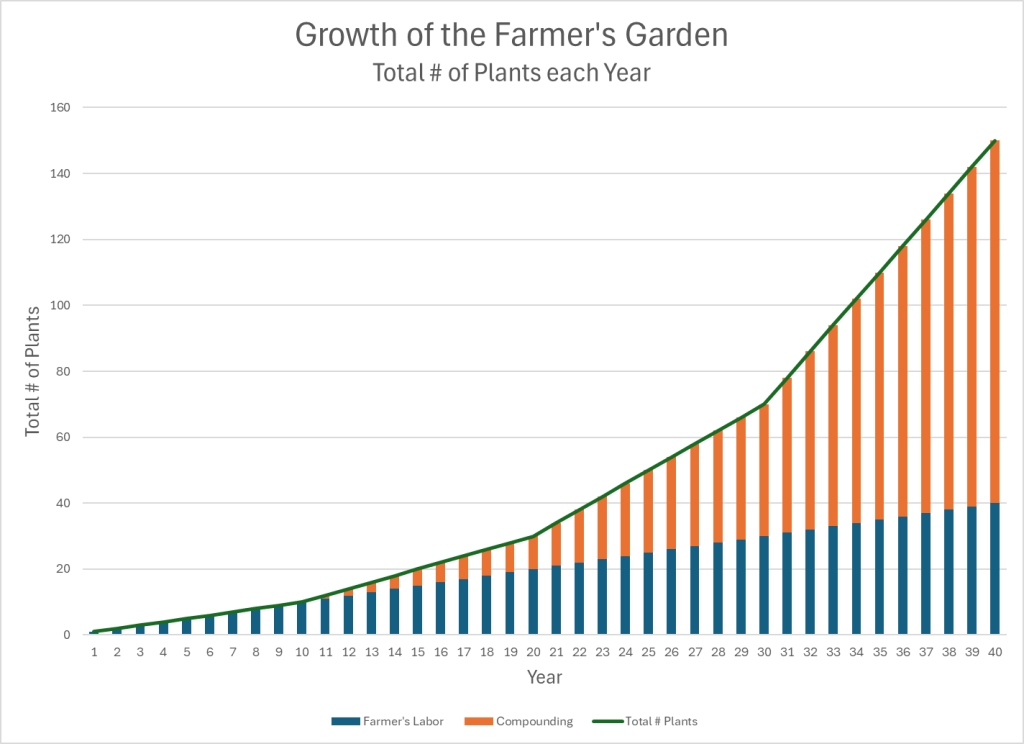
Understanding the Growth of the Farmer’s Garden Chart
The Garden Growth Chart visually displays how compounding overtakes effort:
- The blue bars represent the running total of the farmer’s labor—each seed he personally planted.
- The orange bars represent the running total of seeds produced by the garden itself—compounding.
- The line chart shows the total number of plants in the field each year.
Notice how in the first two decades, the blue bars dominate. Almost all growth comes from the farmer’s effort. At year twenty-five, the orange bar matches the blue bar; this is when compounding equals human effort. From that point forward, every year, the orange bar grows faster than the blue. Compounding is now pulling more than the farmer.
It takes decades for this to happen, at least two to three doubling periods. But by the fourth doubling, compounding fully takes over. That is why staying in the game matters more than starting perfectly.
See Coach Holdren’s Thought Experiment: On Compounding Series. Link to the first article: “On Compounding (Part 1)“.
Wealth Is Built Like a Sports Dynasty
A single championship can happen because of a lucky season, a star player, or a perfectly timed play. A dynasty is something entirely different. It is built over many seasons. It is not dependent on one moment or one person. It is built on a system, a culture of discipline, strong fundamentals, and consistent habits. Players may come and go, coaches may adjust strategies, but the system endures. That is why dynasties win over and over again.
Wealth works the same way. You do not build financial independence with one lucky investment or a single raise at work. You build it by practicing the same core habits repeatedly: spending less than you earn, investing the difference, avoiding debt, and giving your money time to grow. In the beginning, your progress depends on your effort, just like a young team that is still learning how to play together.
Eventually, if you stay disciplined, the system takes over. Your investments begin earning more than you contribute. Compounding becomes your star player. That is when your finances shift from effort-driven to system-driven. That is how wealth becomes a dynasty. But it only happens if you stay in the game long enough.
Why Most People Never See the Harvest
Most people never experience the full power of compounding. The problem is not that compounding fails. The problem is that they quit too soon or raid their accounts before the real harvest arrives.
In the early years, progress feels slow. From year one to five, the account grows, but it is barely noticeable. Then life happens. Around year six to ten, a vacation, a new car, an emergency, or simple impatience leads to withdrawals. When that happens, the clock resets. They go back to year one. The cycle repeats, and compounding never has the chance to take over.
Compounding does not reward the person who starts. It rewards the person who stays. If money grows at roughly seven percent per year, it doubles about every ten years. The first doubling still feels small. The second is encouraging. The third begins to feel meaningful. The fourth and fifth are where the system begins to grow faster than you can. But most people never reach that point. They pull money out during the second double. They raid the account and stop the very process that would have made them free.
Compounding requires three things: time, patience, and the discipline to leave it alone.
Your Role in This Habit
You cannot control the stock market. You cannot control interest rates or the economy. But you can control whether compounding is allowed to work for you.
Your role is simple to understand, but it requires discipline. First, invest consistently. Automate your contributions so your money is planted before you can spend it. Second, protect the field. Avoid high-interest debt, resist panic when markets drop, and do not interrupt the process with emotional decisions. Third, do not raid your account. Compounding needs time to mature. Let it grow through at least four or five doubling periods before even considering withdrawals. Finally, give it decades. Not months. Not a couple of years. Decades.
Your work prepares the field. Time and compounding turn that field into a legacy.
Summary
Core Habit #4 is clear: give it time to grow. You have already created financial margin, invested the difference, and avoided the traps of debt. Now comes the hardest part: being patient. Most people fail here.
They get impatient or expect quick results. They withdraw too early and stop the process just before it begins to accelerate. But if you give your investments enough time, long enough for multiple doubling periods, your field will grow beyond what your labor alone could ever produce. That is when compounding becomes your most valuable player.
Next Up: Bringing It All Together
In the next post, we will combine all four core habits into one complete financial system. You will learn:
- How to calculate your path to Financial Freedom and Independence.
- How to know if your savings rate is enough.
- How to track progress and stay motivated for decades.
- What to do when your garden is mature — how to harvest safely and live fully.
This is where the habits become a lifestyle. This is where the game plan becomes freedom.