Introduction
The Core Financial Habits series laid the foundation for how you build wealth: Spend Less than you earn, Invest the Difference, Avoid Debt, and Give It Time to Grow. Those habits describe what disciplined investors do, and why behavior matters more than brilliance. The On Compounding series takes the next step by showing why those habits work so powerfully over decades. If the Core Habits are the daily practice of planting seeds, then On Compounding is the story of what happens to that garden when patience, consistency, and time are allowed to do their quiet work. Together, these two series form a complete framework: habits create the conditions for success, and compounding is the force that ultimately turns those habits into financial freedom and independence.
Compound interest is one of the most powerful forces in building wealth, yet its true potential often goes unnoticed because it doesn’t operate in a straightforward or linear way. Instead, it grows exponentially, quietly gaining momentum over time. Much like the way a single seed transforms into a towering tree, compounding requires patience and persistence: its impact is slow at first, almost invisible, but over time it becomes unstoppable. To illustrate this concept, I’ll begin with a simple tale about a patient farmer, an extraordinary seed, and a timeless lesson that can reshape the way you think about growing wealth. This is the first in a series of posts that will explore the profound lessons hidden within the art of compounding.
The Farmer’s Compounding Garden
In a small village, farmers whispered about a rare plant with unusual powers. It wasn’t flashy, and it certainly wasn’t fast, which is why most villagers dismissed it. This plant took ten full years before it produced a single piece of fruit. No shortcuts. No exceptions. After that decade passed, each plant produced one fruit every ten years, each fruit containing one seed. And if that fruit was simply left on the soil, it would automatically grow into a new plant. Most of the farmers shook their heads and went back to their traditional crops. They didn’t see the point in tending a plant that demanded such patience. But one farmer did. He saw what it could become over a lifetime, and he made a quiet promise to himself: every year, no matter the season, the weather, the setbacks, or the mood he woke up in, he would plant one new seed.
Decade 1: Ten Years of Silence.
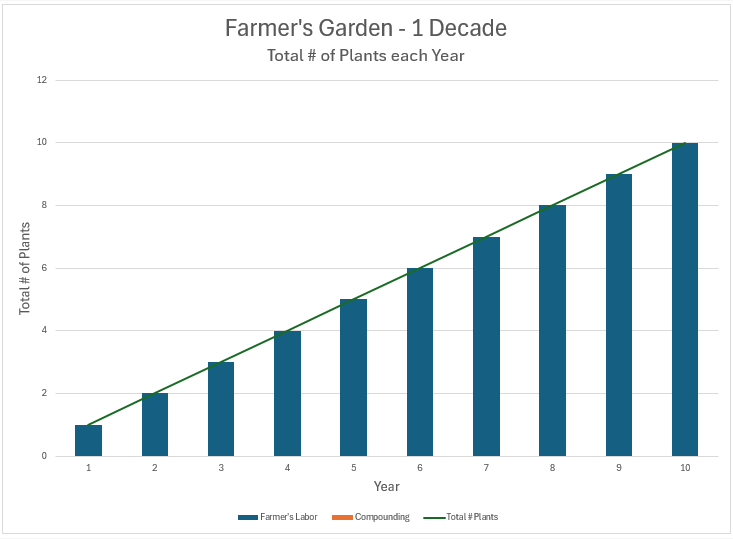
And so he did. For ten years, he faithfully planted one seed each year. He watered the ground, protected the fragile green shoots, and kept the faith. And for ten straight years… nothing happened. No fruit. No new plants. No visible return on all that work. Just ten solitary plants standing in an otherwise ordinary field. This is what the first decade of investing feels like: slow, unrewarding, and silent. It’s the point where a lot of people quit, telling themselves the system doesn’t work or the results are too small to matter. But the farmer kept tending his little field, because he understood something most people do not: discipline and habits are more reliable than motivation, because it shows up even when the results don’t.
Decade 2: The First Signs of Life.
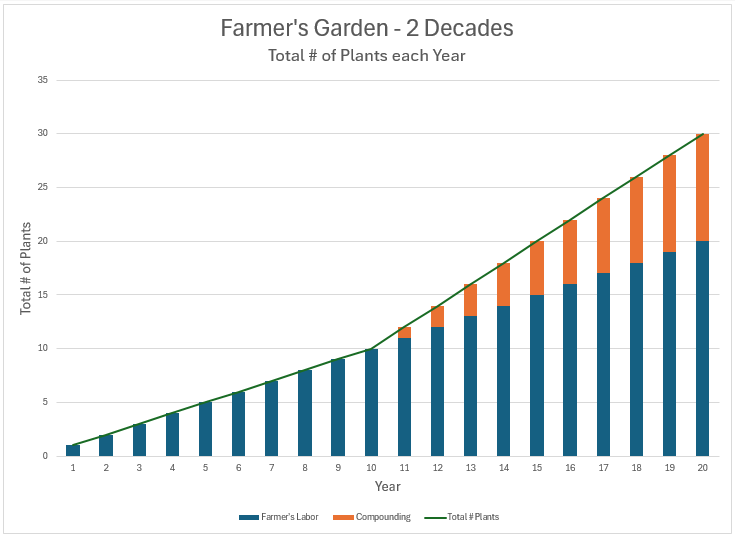
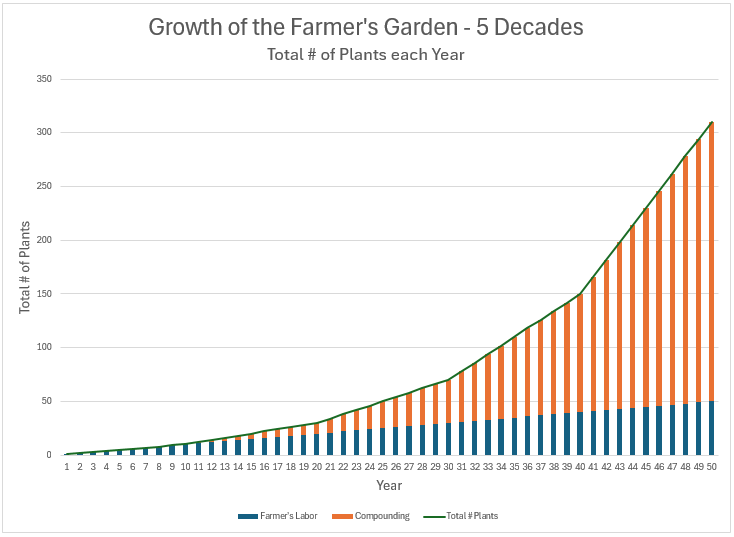
Then came year eleven. One morning he walked out to the field and noticed a single mature plant carrying its first piece of fruit. Inside was one seed. He planted that seed alongside the one he planted himself. The next year, another plant bore fruit. Then another. It wasn’t dramatic, but something important had changed. The garden was beginning to help him. Every year the farmer planted his one seed, and now the garden was adding one of its own. By year twenty, the field had grown to thirty plants; still nothing impressive to someone walking by. Two decades of work for thirty plants? Most villagers would have laughed. But compounding never reveals itself early. It rewards endurance, not applause.
Decade 3: The Turning Point.
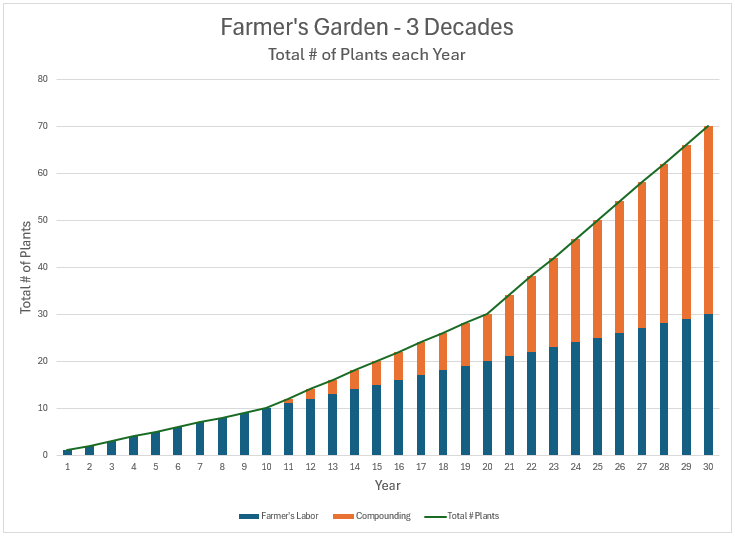
During the third decade, something subtle but profound happened. By year twenty-five, the seeds produced by the garden equaled the total number of seeds the farmer had planted with his own hands over his entire life. The system he had built was now matching his lifetime of effort. This is the moment every investor longs for, even though most never recognize it when it arrives. It is the point where your investments begin contributing as much as you do, simply because you’ve stayed in the game long enough (in this case, 25 years). By year thirty, the field held seventy plants, and the acceleration was undeniable. The garden was no longer dependent on the farmer. In fact, it was beginning to lead the way.
Decade 4: The Garden Overtakes the Farmer.
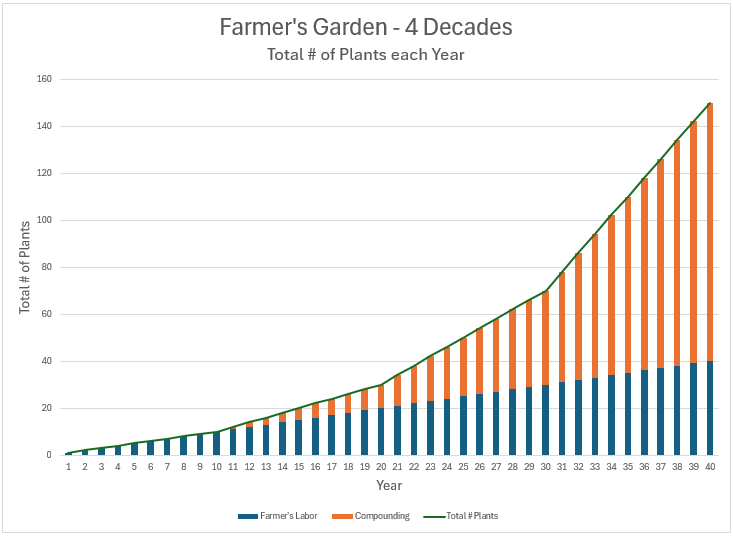
And then the fourth decade arrived—the decade when compounding finally showed its true strength. The farmer continued planting his single seed, but the garden was now producing seven new seeds for every one he planted. What once grew slowly was now growing explosively. By year forty, the field held one hundred fifty plants. Of those, only forty had come from the farmer’s own hands. The other one hundred ten had been produced by time, patience, and the silent work of compounding. The garden was now outproducing the farmer almost three to one. His effort was no longer the primary driver of growth. The system he had built decades earlier was now carrying him forward.
Decade 5: The Self-Sustaining Garden.
As the farmer stepped back and admired his garden at the end of the fourth decade, he noticed something important. The field was now producing enough fruit to sustain itself and continue growing, but was it producing enough for him to live only on the harvest?
The farmer had been planting one seed every year, which represented 10% of his wages, meaning his gross annual income was the equivalent of 10 seeds. Since the farmer planted the equivalent of 10% of his earnings into his garden, he lived on the remaining 90% or 9 seeds.
He used a simple rule handed down by other farmers: never harvest more than four percent of your field in the first year, or you risk damaging the garden’s long-term health. Four percent of a 150-plant field would give him six fruits, far short of the nine he needed to feed his family for the year. The garden was powerful, growing faster than he ever could alone, but it wasn’t quite ready to take over completely. Not yet. He needed the field to reach at least 225 plants before it could fully support his life without shrinking. Here the Farmer, has a choice. He can let the garden just grow on its own until it reaches 225 (or more) plants in the field. Or he can continue to do what he has always done and plant one seed per year.
So the farmer did what he had always done. He planted one more seed that year. And the next. And the next. During the fifth decade, the garden’s compounding power accelerated beyond anything he had seen before. By the end of Year 50, the field held 310 plants. At a four percent harvest rate, the garden could now produce over twelve fruits per year; more than enough to sustain the farmer’s needs while still leaving the field stronger than before.
A Self-Sustaining System
At the end of the fifth decade, the farmer stood in his field and realized something had changed. The garden no longer needed him. It would continue to grow whether he planted seeds or not. It was now a self-sustaining ecosystem, capable of producing more than enough fruit not just to plant future seeds, but to feed him for the rest of his life. He had options he never had before. He could continue planting one seed each year, allowing the garden to grow even faster. He could stop planting altogether and simply let the field expand on its own. He could begin harvesting the fruit responsibly, selling it at market, and living off the production without shrinking the field itself, while still being able to grow the garden at a much slower rate. This, right here, is the moment of financial independence; not an age, not a retirement account number, but the quiet point in life when your system produces more than your effort. That is the magic of compounding! But notice, this took five decades for the results to appear.
Very Few People Achieve This Point
Sadly, most people never experience this moment. Not because compounding doesn’t work, but because they never stay with the process long enough to discover what it can do. They quit in the silent years. They pull money out during the first slow doubling period. They raid their accounts when life gets busy or tempting. They stop investing when the results seem too small to matter. And every time they do this, they reset the clock. They go right back to Year One. Right back to the slow part. Right back to wondering why compounding never works for them.
The Lesson of the Compounding Garden
But the lesson of the Compounding Garden is clear: compounding is not designed to reward the person who starts; it is designed to reward the person who stays put and lets the garden quietly expand. Wealth is not built by brilliance or luck or perfect timing. It is built by the simple, almost boring discipline of planting one seed every year and refusing to pull it out of the ground. Your role is to plant and protect. Time’s role is to multiply. Compounding’s role is to take your modest effort and over decades turn it into something far greater than the sum of its parts.
This is how wealth is built. This is how financial freedom is earned. And this is how your financial garden becomes a self-sustaining legacy. It doesn’t happen quickly. It doesn’t happen loudly. It doesn’t happen dramatically. But if you stay committed long enough, it will happen.
Up Next…
This story serves as a gateway to understanding the remarkable power of compound interest; a force that transforms patience and consistency into extraordinary outcomes. In the upcoming series of posts (Part II, Part III, Part IV and Part V), we will delve deeper into the Farmer’s Compounding Garden, uncovering the valuable lessons embedded in this simple yet profound tale. Together, we’ll explore how these insights can be applied to shape your financial journey and unlock the true potential of compounding.
In Part II we will discuss 8 key insights we can extract from the analogy of the Farmer’s Compounding Garden.